

We’ve just had our first full year of average global temperatures exceeding 1.5°C above pre-industrial levels.1 That number was highlighted in the 2015 Paris Agreement to hold “the increase in the global average temperature to well below 2°C above pre-industrial levels” and pursue efforts “to limit the temperature increase to 1.5°C”.2 Because long-term climate change is measured in global averages over decades, we did not officially reach the Paris 1.5°C last year. But things are bad enough.
Looking at the average global temperature doesn’t tell you what the worst was, how warming is not evenly distributed geographically, or how climate change is experienced locally and personally. The devastation of the Los Angeles fires is unthinkable, until something like it happens to you. Fires are now hotter, bigger, faster; and not limited to California, a fire season, or forests.3 Each additional fraction of a degree of warming brings worse heatwaves, heavier precipitation, more drought and fire. But while 1.5°C was never a promise of safety, passing it does not signify doom.
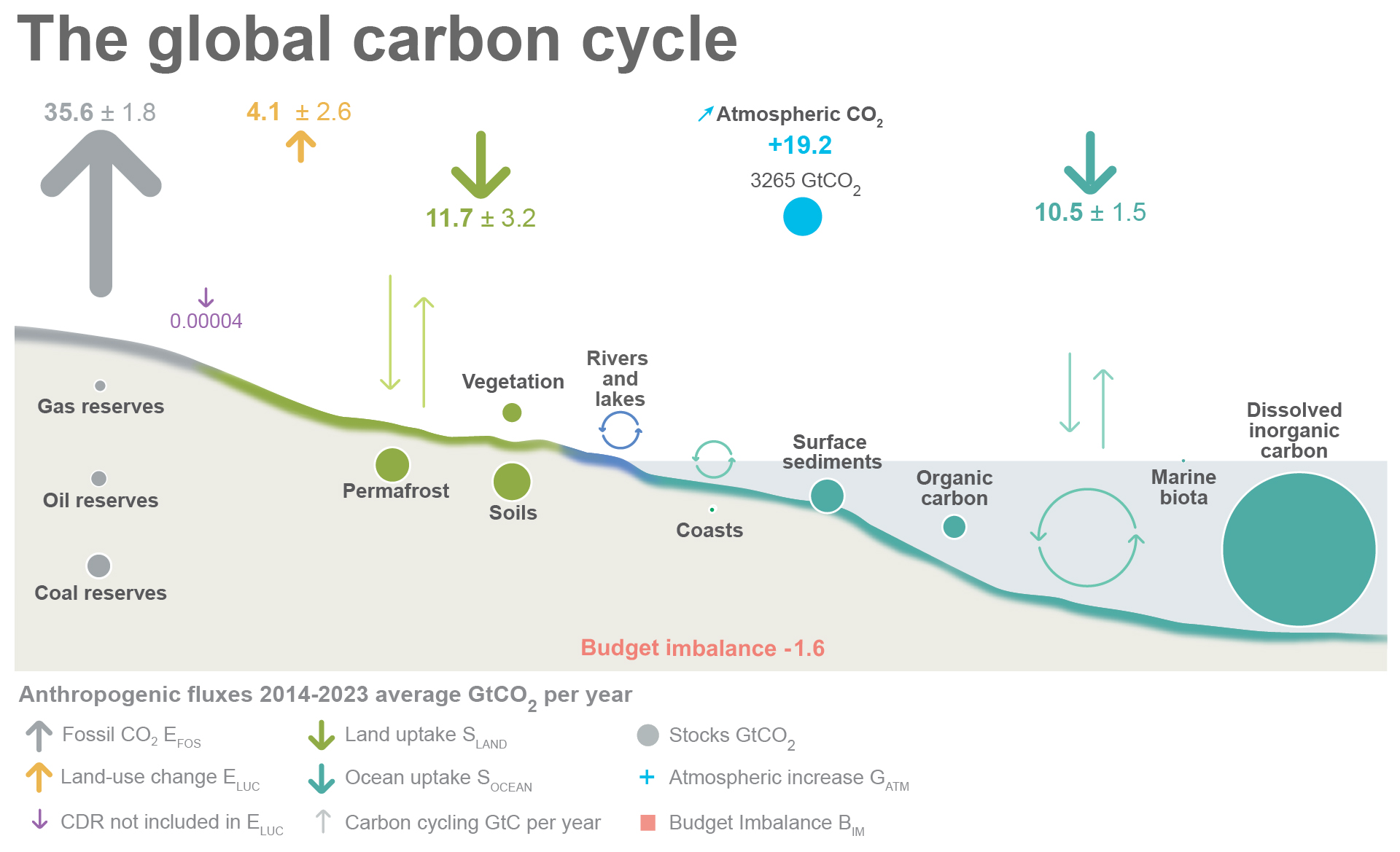
There are risks with warming for abrupt or irreversible shifts in large scale systems, such as collapse of the Greenland and West Antarctic ice sheets, altered ocean circulations, or loss of unique ecosystems. These occur once a change becomes self-perpetuating through feedback and a “tipping point” is passed.4,5 At what point this happens is uncertain, and thresholds may lie above or below 1.5°C. Ice sheet melt with rising sea levels and coral reef die-off are happening now. Looking at the global scale of Earth’s carbon and water cycles, natural “carbon sinks” such as forests, soil, and oceans have absorbed half the carbon humans have emitted thus far. These systems can be impaired, though, by deforestation and fires and by warming of oceans that causes them to absorb less CO2.6
We know what to do. If we set 1.5°C as our desired temperature limit, we can figure out the total amount of atmospheric CO2 that is consistent with this, and then plot CO2 emissions to stay within that carbon budget. Optimally, CO2 emissions halve from 2010 levels by 2030, and reach zero by 2050. Methane pollution also falls.7 What counts is the cumulative CO2. If we delay lowering emissions or decrease them more gradually, either more CO2 gets added to the total and the Earth warms past 1.5°C,8 or, a precipitous drop to zero is needed decades sooner,9 to remain within the same carbon budget.
In alternate “overshoot” pathways, warming exceeds 1.5°C then returns to 1.5°C. This is not the same as holding to 1.5°C, however, because the hazards and risks of warming beyond 1.5°C will be present for the duration of the overshoot, to whatever peak temperature. Also, this is risky because it relies on carbon dioxide removal methods that do not yet exist or that are unproven at scale.10
There has been progress,11 thanks in part to rallying for 1.5°C. Before the Paris Agreement, it was hard to imagine the decline of coal, or the rise of wind and solar energy.12 Solar is blooming around the world, from giant farms13 to balconies.14 Batteries are cheaper and electric vehicle sales continue to rise. Did you know that the band a-ha played a role in Norway’s EV revolution?15
As the Earth brushes up against 1.5°C, I remind myself of the many reasons to avoid any more warming and why rapid decarbonization is so urgent. It’s not the temperatures we care about, but the impacts to humans and the natural Earth. Global warming at 1.5°C is bad enough, but it is not a point of no return. Preventing more warming will always be worthwhile, to lessen harm. No matter what the temperature is, the key to limiting warming is how fast we lower carbon emissions. What the Paris Agreement failed to say, is that reducing emissions means we stop burning fossil fuels.16 We switch to energy sources that are cleaner, more efficient, and safer than oil, gas, and coal. Global carbon emissions have not yet started to descend!17 The aim is for zero emissions. The time to bend the emissions curve sharply down is now. Let 2025 be remembered as the year carbon emissions peaked.
REFERENCES
- What’s in a number? The significance of the 1.5°C warming threshold and reporting on its possible breach in popular media. May 2023 (https://science.feedback.org/significance-1-5c-warming-threshold-reporting-possible-breach-popular-media/).
For more details: State of the climate: 2024 sets a new record as the first year above 1.5C. Z Hausfather, Jan 2025 (https://www.carbonbrief.org/state-of-the-climate-2024-sets-a-new-record-as-the-first-year-above-1-5c/) ↩︎ - The Paris Agreement, UNCC (https://unfccc.int/process-and-meetings/the-paris-agreement) ↩︎
- Whiplash: how big swings in precipitation fueled the LA fires. E Kolbert, Jan 2025 (https://e360.yale.edu/features/daniel-swain-interview). See also Daniel Swain’s blogpost: Hydroclimate volatility on a warming Earth, DL Swain, Jan 15, 2025 (https://weatherwest.com/archives/43181). ↩︎
- Exceeding 1.5°C global warming could trigger multiple climate tipping points – paper explainer. DI Armstrong McKay et al, Sep 2022 (https://climatetippingpoints.info/2022/09/09/climate-tipping-points-reassessment-explainer/) ↩︎
- ‘Scientists question the use of “Tipping point” metaphor in climate change discussions. K MacPherson, Dec 2024 (https://cpree.princeton.edu/news/2024/scientists-question-use-“tipping-point”-metaphor-climate-change-discussions) ↩︎
- The global carbon budget: FAQs (https://globalcarbonbudget.org/faqs/) and
The global carbon cycle visualization (https://robbieandrew.github.io/GCB2024/PNG/s09_2024_global_perturbation.png) ↩︎ - Global warming of 1.5°C, IPCC special report, 2018 (https://www.ipcc.ch/sr15/). Chapter 2. (Note that I am focusing on mitigation, to reduce the greenhouse gas emissions that cause climate change. Adaptation strategies for managing climate change hazards and risks are also important.) ↩︎
- Net-zero: it’s not just where you end up, but how you get there that matters. H Ritchie, Oct 2023 (https://www.sustainabilitybynumbers.com/p/net-zero-delay) ↩︎
- The rapidly shrinking carbon budget. Z Hausfather, Jun 2023 (https://www.theclimatebrink.com/p/the-rapidly-shrinking-carbon-budget) ↩︎
- Overconfidence in climate overshoot. C-F Schleussner et al, Oct 2024 (https://www.nature.com/articles/s41586-024-08020-9.pdf) ↩︎
- Building a good Anthropocene: 2024 reviewed as 2025 dawns. S Matey, Jan 2025. A dizzying collection of positivity. (https://storymaps.arcgis.com/stories/4f0ed22ac65b478ba467bbcff6e867e4). The author’s The Weekly Anthropocene blog features upbeat, international, biosphere-inclusive news. ↩︎
- The energy transition in five charts and not too many numbers. S Butler-Sloss & K Bond, May 2023
(https://rmi.org/the-energy-transition-in-five-charts-and-not-too-many-numbers/) ↩︎ - Photos: the growth of solar-power stations. A Taylor, accessed 24Jan2025, The Atlantic (https://archive.is/2023.11.27-202305/https://www.theatlantic.com/photo/2023/11/photos-solar-power-stations/676114/) ↩︎
- How Germany outfitted half a million balconies with solar panels. A Hu, Sep 2024 (https://grist.org/buildings/how-germany-outfitted-half-a-million-balconies-with-solar-panels/) ↩︎
- Norway’s electric car triumph started with an ‘80s pop star. W Doig, Feb 2021 (https://reasonstobecheerful.world/norway-gm-electric-cars-morten-harket/) ↩︎
- The failures of the Paris climate change agreement and how philanthropy can fix them. T Odendahl, Jan 2016 (https://ssir.org/articles/entry/the_failures_of_the_paris_climate_change_agreement_and_how_philanthropy_can). (There are other problems, too.) ↩︎
- World Energy Outlook 2024, press release (https://www.iea.org/news/geopolitical-tensions-are-laying-bare-fragilities-in-the-global-energy-system-reinforcing-need-for-faster-expansion-of-clean-energy). Global emissions are set to peak imminently, but have to decline rapidly. Demand for coal, oil and gas is projected to peak by the end of the decade. We’re moving into the Age of Electricity, with increasingly more clean energy sources. ↩︎
 cloudy climate
Leave a comment