
Are there four or five oceans? There’s the Pacific, Atlantic, Indian, and Arctic, and after a half century out of favor, the Southern Ocean is once again recognized.[1] The Southern Ocean, fourth largest, is not bound by land masses like the others but encircles Antarctica. There’s really only one ocean, though, interconnected by a “global conveyor belt” of thermohaline circulation, driven by temperature (thermo) and salinity (haline) gradients.
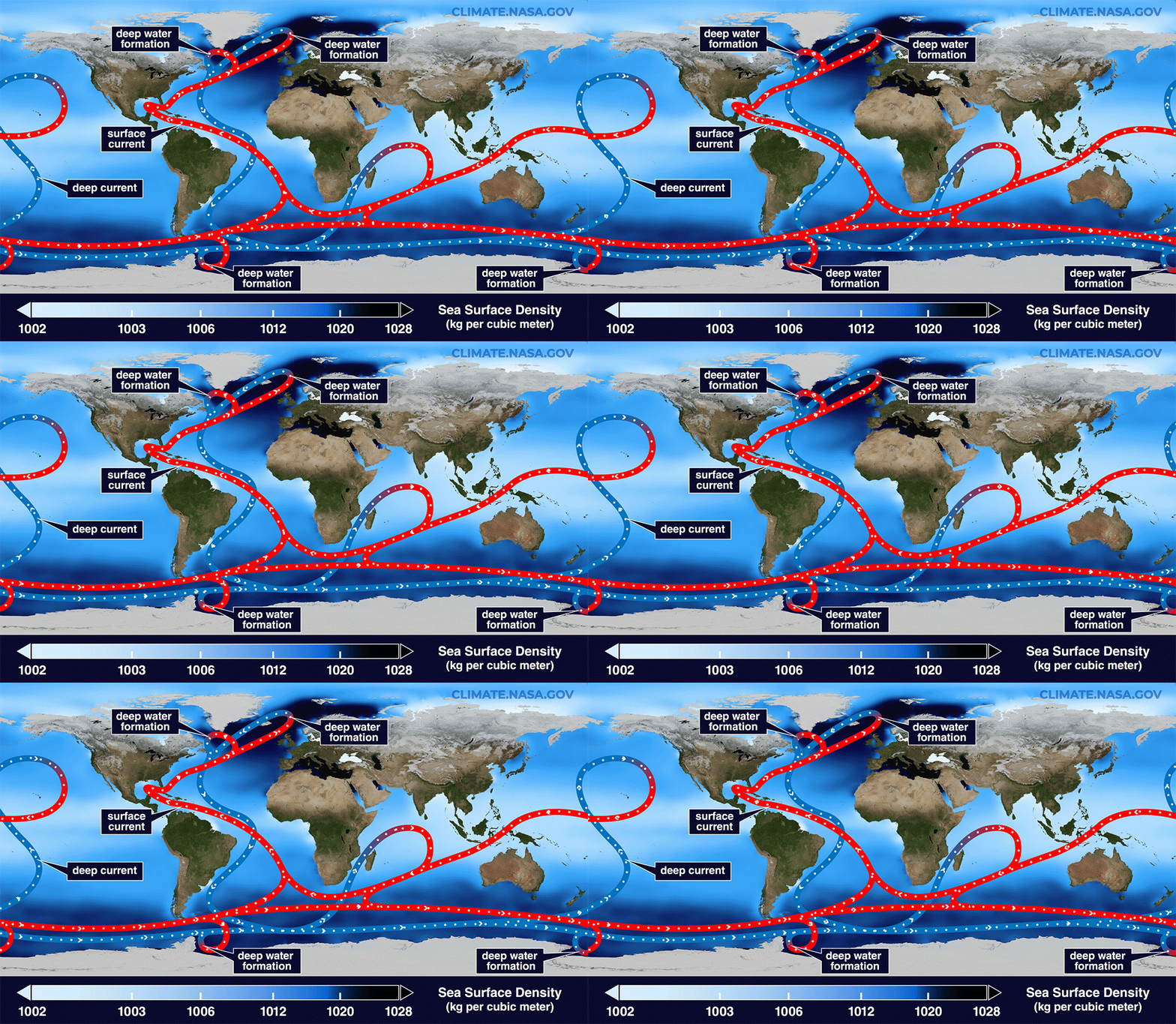
Image credit: NASA
The part of the conveyor belt that spreads warmth from tropical latitudes northward is the Atlantic Meridional Overturning Circulation or AMOC. Ocean water cools near the pole and gets saltier, as ice forms and salt is left behind in the surrounding water. The denser, colder and saltier water sinks and moves southward at depth, while surface water moves in to replace it, creating a current.[2]
The deep water gets “recharged” in the Southern Ocean, where it picks up more cold, salty, dense water and joins the Antarctic Circumpolar Current (ACC), the strongest ocean current on the planet. The ACC splits off northward into the Indian and Pacific Oceans, absorbs heat, and loops back, to eventually return to the Atlantic. Strong westerly winds bring masses of cold water to the surface,[3] upwellings that absorb heat and carbon before sinking again. Globally, the ocean has taken up a quarter of our excess CO2 emissions and 90% of the trapped heat, much of this happening in the Southern Ocean.

Nutrient-rich upwelling promotes biologic growth. Phytoplankton are consumed by trillions of krill, about a half gigaton altogether, making Antarctic krill the most abundant species on the planet that can be seen without a microscope.[4] Their fecal pellets sink, storing 20 million metric tons of carbon a year.[5] Krill are the keystone of the Antarctic food web. The 5-cm-long, shrimp-like crustaceans provide food for a range of marine animals including penguins, seals, fish, squid, and whales.
The ocean has a fever. The Arctic is warming four times faster than the planet as a whole. As reflective, high-albedo sea ice is lost, the exposed darker ocean absorbs more heat, leading to more melting, in a feedback loop. Sea ice has been shrinking since satellite monitoring began in 1978. The Antarctic more puzzling. After several relatively stable decades, sea ice extent hit record highs in 2007-2016, followed by record lows since.[6] Ice shelves, floating extensions of the ice sheet, are breaking up, removing a barrier to glacial flow into the sea. Ice loss from the West Antarctic Ice Sheet is speeding up.[7] There is concern that the Greenland and Antarctic ice sheets are near a point of irreversible collapse, committing to several meters of sea level rise over centuries.[8] Another concern is ocean currents. Meltwater decreases salinity, and less dense water is less inclined to sink, gumming up thermohaline circulation. The AMOC may be slowing.[9] The ACC could also decline in strength, lessening its ability to take in heat and CO2.[10]
Much marine life depends on sea ice. Krill feed on algae that grow beneath the ice. Seals, penguins, and others rely on it for habitat or breeding Atop the ice, emperor penguin couples court, penguin Dads huddle over eggs, and chicks develop the specialized plumage they need to survive in icy waters. When sea ice melts too soon, the chick fledglings die. Colonies of emperor penguins in the Antarctic Peninsula are disappearing.[5] Krill face an even more immediate threat – industrial fishing. Trawlers hoover up increasing quantities, not to feed humans, but to process into food for farmed salmon and shrimp, pet food, and omega-3 supplements. What’s bad for krill is bad for the Antarctic ecosystem.[11]
Why do I care about the Southern Ocean? Its mighty ACC and upwellings absorb a lot of CO2 and heat, blunting the full force of global warming. Krill and whales and other sea life are part of the biological carbon pump that helps to export carbon into deeper waters. The Antarctic may be harsh and desolate, but its ocean is full of life. The Southern Ocean is mysterious. Collecting local data is difficult, so there are still uncertainties and surprises. Protecting the Southern Ocean helps the Antarctic ecosystem and helps us too.[12]
REFERENCES
- M Rosenberg, updated May 2025. The new fifth ocean (https://www.thoughtco.com/the-new-fifth-ocean-1435095)
- The global conveyor belt. National Oceanic and Atmospheric Administration (NOAA) (https://oceanservice.noaa.gov/education/tutorial_currents/05conveyor2.html)
- Morrison AK, et al, Jan 2015. Upwelling in the Southern Ocean (https://doi.org/10.1063/PT.3.2654)
- What the Wild Sea Can Be. The Future of the World’s Ocean, by Helen Scales, 2024. A marine biologist brings the ocean to life.
- Annesha FA, Nov 2024. Antarctic krill store massive amounts of carbon in the deep ocean, researchers find (https://news.mongabay.com/2024/11/antarctic-krill-store-massive-amounts-of-carbon-in-the-deep-ocean-researchers-find/)
- Gautier A, Jul 2024. Has Antarctic sea ice hit a breaking point? (https://nsidc.org/learn/ask-scientist/has-antarctic-sea-ice-hit-breaking-point)
- Antarctic and Southern Ocean Coalition. Ice sheet in decline (https://www.asoc.org/learn/antarctic-ice-and-rising-sea-levels/#west). Melting land ice, from ice sheets (>50,000 km2) and glaciers, contributes significantly to sea level rise, unlike sea ice and floating ice shelves that don’t add water when they melt. The Greenland and Antarctic Ice Sheets are the Earth’s two current ice sheets.
- Stokes CR, et al, May 2025. Warming of +1.5 C is too high for polar ice sheets (https://doi.org/10.1038/s43247-025-02299-w)
- Rahmstorf S, Sep 2024. Is the Atlantic overturning circulation approaching a tipping point? (https://doi.org/10.5670/oceanog.2024.501)
- Sohail T, et al, Mar 2025. Decline of Antarctic Circumpolar Current due to polar ocean freshening (https://iopscience.iop.org/article/10.1088/1748-9326/adb31c)
- Taylor T et al, Apr 2025. The krill catastrophe: a crucial Antarctic creature doomed by geopolitics and overfishing (https://pulitzercenter.org/stories/krill-catastrophe-crucial-antarctic-creature-doomed-geopolitics-and-overfishing)
- Operation Antarctica Defense, Sea Shepherd (https://www.seashepherdglobal.org/our-campaigns/antarctica-defense/learn-more/). The Australians have the Bob Brown Foundation: Krilling Antarctica (https://endkrillfishing.org.au)
AUDIOVISUAL TIDBITS
- Mar 2025. An ocean in motion: NASA’s mesmerizing view of Earth’s underwater highways (https://science.nasa.gov/earth/oceans/an-ocean-in-motion-nasas-mesmerizing-view-of-earths-underwater-highways/)
- Oct 2025. Listen to the Arctic’s ‘Underwater Jungle’ (https://www.nytimes.com/2025/10/03/climate/sounds-of-climate-change.html)
 cloudy climate
Leave a comment