
The United Nations Convention on the Law of the Sea (UNCLOS) is the international legal backbone of ocean governance.[1] Defined maritime zones include territorial sea extending 12 nautical miles (M) from the coast, the exclusive economic zone where rights to sole exploitation continue another 200 M, and high seas or international waters beyond. States have a duty to protect and preserve the marine environment. There is freedom of the high seas; every state is free to sail ships, fish, and perform other peaceful activities.
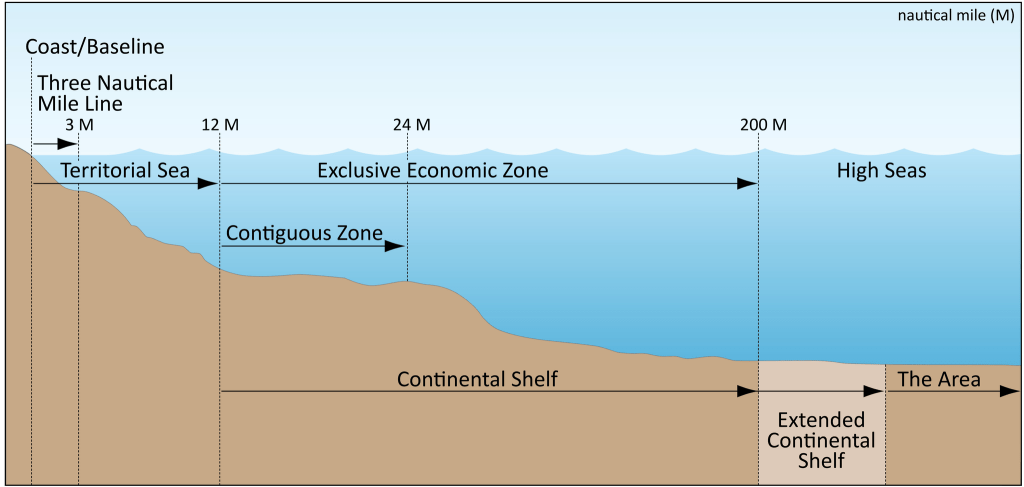
The seabed (“the Area”) is the common heritage of mankind and benefits from its resources are to be fairly shared. The US objected to this as not free-market friendly and did not ratify the UNCLOS.[2] Scientists and others are calling for a moratorium, but the International Seabed Authority failed to rule on deep-sea mining in 2025. The US on its own is preparing to mine international sea floor.[3][4]
Over a third of marine fishery stocks are overfished.[5] A hodgepodge of fishery bodies, variously set up by region or targeted stock, manage marine resources.[6] Climate change adds new stressors. For example, as waters warm and mackerel migrate northward, should Icelandic fisherman catch the now nearby mackerel, or should existing allotments to nations be preserved? Even with Iceland a member since 2010, the relevant fishery body has reached no consensus and the mackerel dispute continues.[7] A separate issue is illegal fishing, which has been difficult to police across the vast ocean. The World Trade Organization’s Agreement on Fisheries Subsidies, in effect in 2025, targets illegal fishing and overfishing by prohibiting subsidies linked to these activities.[8]
After ratification by 60 nations in 2025, the Biodiversity Beyond National Jurisdiction (BBNJ) agreement or High Seas Treaty is now in effect.[9] It has four themes:
- area networks of Marine Protected Areas (MPAs) in the high seas
- environmental impact assessments
- equitable sharing of benefits from marine genetic resources
- development and transfer of marine technology
MPAs conserve ecosystems and allow populations to regenerate, but currently protect only 9.6% of mostly coastal ocean, and only 3.2% is highly protected.[10] The BBNJ facilitates the establishment of MPAs in international waters, toward a goal of protecting 30% of the ocean by 2030 (Kunming-Montreal Global Biodiversity Framework). The first generation of high seas MPAs could include the Lost City hydrothermal vent, seamounts, and the Sargasso Sea.[11] The BBNJ will cooperate with existing agencies and can help bring cohesion to the fragmented fishery bodies and MPAs.
The UN International Maritime Organization crafted a plan for lowering the carbon emissions from shipping, which make up 3% of global emissions. The Net-Zero Framework incorporated carbon trading for high emitters, a flat fee per ton of emissions for lesser emitters, and rewards for meeting set fuel emission levels that would over time near zero.[12] The US vigorously objected and the 2025 vote was put off for one year. Another approach is to look at options that increase efficiency, such as slower sailing, wind power retrofits, and coordinating with ports to reduce waiting time. These could be effective near-term and are already available to many ships globally.[13]
Much of the world’s plastic waste winds up in the ocean. Some 39,000 tons float on the surface; tinier bits mixed with marine snow are eaten by sea life; a plastic bag and candy wrappers soil even the Mariana Trench.[14] We did not get a Global Plastics Treaty in 2025. There is a gulf between those who would curb plastic production at the source and the nations who manufacture plastics from fossil fuel raw materials, who advocate for downstream recycling and waste-management.[15]
Following campaigning by Vanuatu, Pacific Islands, and youth organizations, the International Court of Justice (ICJ) issued Obligations of States in respect of Climate Change in 2025. In the Advisory Opinion, states have an obligation to ensure the protection of the climate system from harms from greenhouse gas emissions, and failure of a state to take appropriate action to prevent harm from fossil fuel production, consumption, granting of exploration licenses, or subsidies may constitute an internationally wrongful act. Sea-level rise does not alter the territorial rights of existing maritime states.[16]
My look back at 2025 reveals many voices and many tensions. If every state is free to take from the sea, those able to harvest resources reap the benefits, leaving others out.[17] The US is on an extraction spree for oil, gas, and coal, lumber, fish, and minerals. If common heritage means ownership by all, on the other hand, actions should be in the best interests of the collective whole and benefits equitably distributed, as in BBNJ guidance on marine genetics.
We begin to realize that the ocean and its ecosystems are vital to life on planet Earth, to see that the seas are not just here to serve us. The BBNJ focuses on conservation and biodiversity and the ICJ advised on state’s duties around climate change harms. But no international agreements were achieved in 2025 on deep sea mining, shipping, or plastics. Financial gain outweighs non-monetary value, as when we harvest Antarctic krill despite its key role in the Southern Ocean food web, risk ecosystems to mine the seabed, and accept no limits on pollution.
Balances between market, state, people, and the natural world are out of whack. I do support the United Nations, treaties, and law, constructs for rules-based order that are more fragile than I supposed. Let’s keep at it, try new kinds of collaborations of the willing, build on local and national successes, speak to add our voices.
WHAT YOU CAN DO
- Tell your legislators that you think the ocean, protected waters, and deep sea are important. Vote.
- Volunteer for local beach clean-ups or join a group that supports marine conservation.
- If you eat seafood, think about whether it was caught sustainably.[19]
- Opt for reusable items over single-use plastics. Refuse, reduce, reuse, repurpose, recycle.
- Ask how your city is dependent on fossil fuels and push for renewable energy and electrification. Fight for the preservation of natural landscapes, seascapes, and resources.
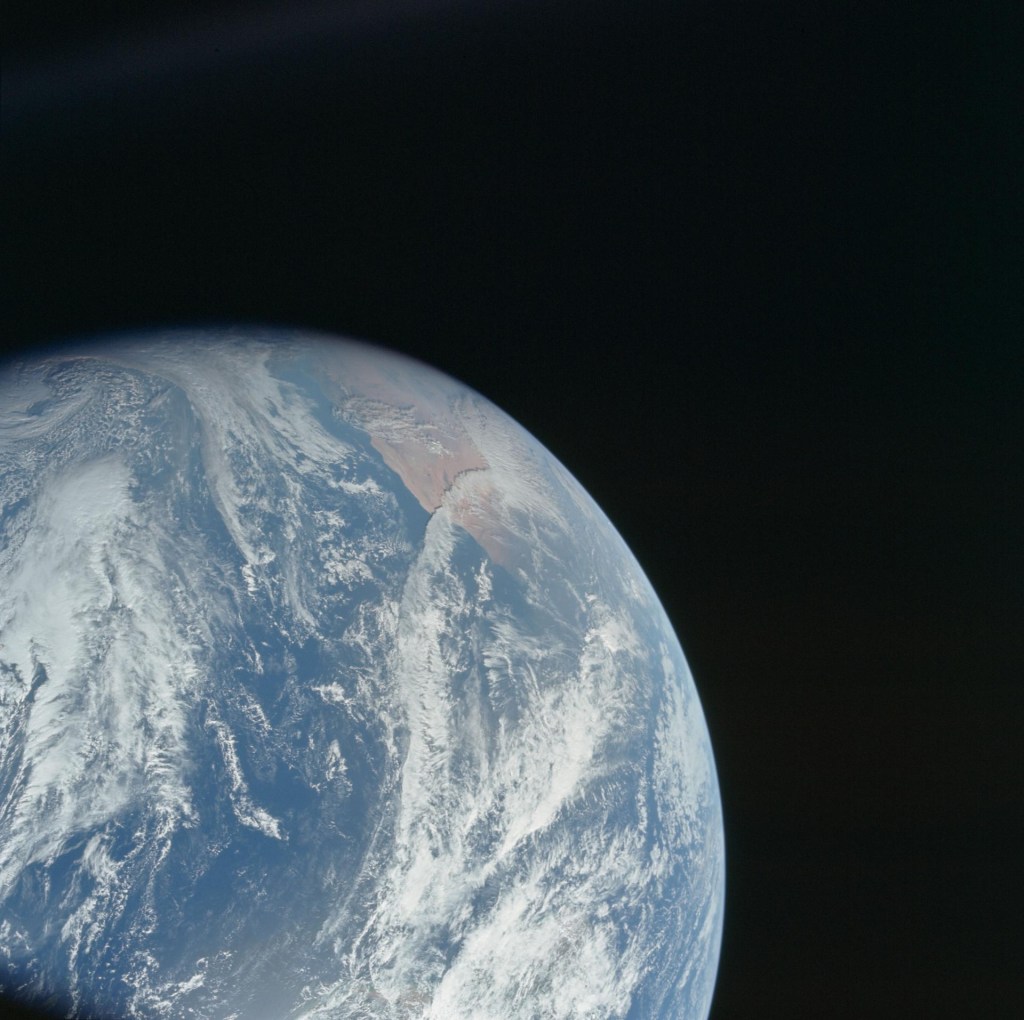
NOTES: This article evolved from “Who Speaks for the Ocean?” in the February 2026 Fridays For Future Newsletter (https://www.fridaysforfuturenewsletter.org/post/who-speaks-for-the-ocean). The photo of Earth and ocean is from NASA.
REFERENCES
[1] United Nations Convention on the Law of the Sea (https://www.unclos.org). Part VII-freedom of the seas; part XI-the Area (seabed); part XII-protection and preservation of the marine environment
[2] United States and the United Nations Convention on the Law of the Sea, accessed 4 Feb 2026 (https://en.wikipedia.org/wiki/United_States_and_the_United_Nations_Convention_on_the_Law_of_the_Sea)
[3] Q&A: What does deep-sea mining mean for climate change and biodiversity loss? Chandrasekhar A et al, updated Jan 2026 (https://interactive.carbonbrief.org/deep-sea-mining/index.html)
[4] The deep sea. Dec 2025 (https://cloudyclimate.org/2025/12/30/the-deep-sea/)
[5] Fish and overfishing. Ritchie H & Roser M, updated Mar 2024 (https://ourworldindata.org/fish-and-overfishing)
[6] The role of regional fishery bodies. Into the next millennium: fishery perspective. Hongskul V, Nov 1999 (https://www.fao.org/4/X6947E/x6947e0a.htm)
[7] The fish that ate an agreement: how migrating mackerel undermine international fisheries cooperation. Kapstein EB et al, Jul 2023 (https://carnegieendowment.org/research/2023/07/the-fish-that-ate-an-agreement-how-migrating-mackerel-undermine-international-fisheries-cooperation)
[8] Fisheries subsidies agreement: why it matters. Oct 2025 (https://www.pew.org/en/research-and-analysis/fact-sheets/2025/10/fisheries-subsidies-agreement-why-it-matters)
[9] Agreement under the UNCLOS on the Conservation and Sustainable Use of Marine Biological Diversity of Areas beyond National Jurisdiction, 2024 Factsheet1 (https://www.un.org/Depts/los/reference_files/BBNJ/bbnjagreementoverviewfactsheet.pdf)
[10] The Marine Protection Atlas, accessed 16 Jan 2026 (https://mpatlas.org)
[11] The hidden natural wonders of the world (https://mpa.highseasalliance.org)
[12] The entire world was ready to reduce shipping emissions. Then Trump stepped in. Sadasivam N, Oct 2025 (https://grist.org/transportation/shipping-carbon-tax-international-maritime-organization-trump/)
[13] Harnessing wind, slower speeds, efficient routing to reduce climate impact. Brown K, Mar 2025 (https://maritime-executive.com/editorials/harnessing-wind-slower-speeds-efficient-routing-to-reduce-climate-impact)
[14] The Brilliant Abyss, by Helen Scales, 2001. See chapter “The Eternal Junkyard”
[15] How can we solve the plastic pollution crisis? Lee-Emery A, et al, Sep 2025 (https://www.wri.org/insights/plastic-pollution-global-plastics-treaty-explained)
[16] ICJ: what the world court’s landmark opinion means for climate change. Multiple authors, Jul 2025 (https://www.carbonbrief.org/icj-what-the-world-courts-landmark-opinion-means-for-climate-change/)
[17] A new start for marine management, 2026 (https://worldoceanreview.com/en/wor-9/a-new-start-for-marine-management/time-for-a-genuine-rethink/)
[18] What you can do; sustainable seafood guide, Monterey Bay Aquarium (https://www.montereybayaquarium.org/act-for-the-ocean/sustainable-seafood/what-you-can-do). Sustainable fishing means not harming habitats, not killing lots of “bycatch,” not overfishing. Avoid long-lived and deep-sea fish (like 200-year-old orange roughy and Patagonian and Antarctic toothyfish marketed as Chilean seabass) that mature late, making recovery from overfishing difficult.
 cloudy climate
Leave a comment