
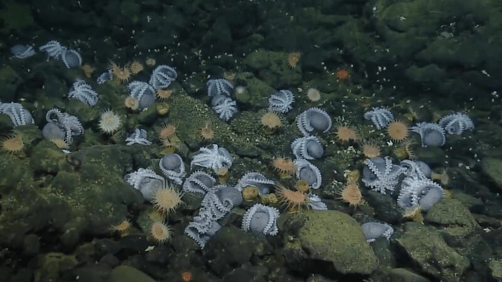
The deep sea, below 200 meters where light becomes scarce, is not lifeless. For example, seamounts are hotspots of biodiversity. As ocean currents meet these underwater mountains, upwellings lift nutrients to the surface, fostering phytoplankton growth and rich feeding grounds for fish, marine mammals, and seabirds. Seamounts are stopovers for migratory species such as sharks and whales. Sessile corals and sponges attach to rocks, feed on planktonic food carried by currents, and in turn shelter crabs, lobsters, and sea stars.1 Few seamounts have been explored and it was a surprise in 2018 to find thousands of deep-sea octopuses nesting at the base of the Davidson Seamount in Monterey Bay. Instead of taking 5-10 years in colder waters, pearl octopus eggs can hatch in less than two years in this warm-water seep.2
Hydrothermal vents arise where water penetrates deep into the Earth’s crust and superheated fluid is ejected.3 Even here, there is life, some based on chemosynthesis rather than photosynthesis, processing chemicals rather than light. Hydrothermal vents may be where life originated on Earth.4
Polymetallic nodules are targets of deep-sea mining. These potato-sized accretions of manganese, nickel, copper, cobalt are strewn across abyssal plains and are especially rich in the Clarion-Clipperton Zone (CCZ), 1.7-million-square-miles stretching from Hawaii to Mexico. The nodules form very slowly, over millions of years, and are not just rocks but rich ecosystems.5 Perhaps 90% of CCZ species are new to science.6 Other mining proposals look at harvesting metal-rich sulfide deposits at hydrothermal vents and scraping crusts of dissolved and accumulated metals from the tops of seamounts.
Proponents of deep-sea mining say minerals are needed for green technology and that it can lessen the need for damaging terrestrial mining, with little environmental impact underwater. But deep-sea mining is not needed, not easy, and not risk-free. Too little is known about the deep sea to say what might be lost.
- The mining process involves a seafloor collector, vertical transport to a surface vessel, and discharge of sediments and water back into the ocean.7 There would be direct damage to the seabed and its life. Carbon stored in the seafloor could be disturbed. Sediment plumes and noise could harm delicate animals in midwater ecosystems that are key to ocean food webs and carbon export.
- Long-term effects are hard to predict, but habitat and diversity losses could linger for decades.8
- There are technical and financial challenges to operating heavy machinery in the deep sea.
- Other terrestrial sources of minerals exist. Recycling can improve. Evolving technology may turn to different minerals.9
The deep sea also faces threats from offshore oil and gas, telecommunications cables, plastics and other pollution, and climate change. Today the main threat to the seafloor is fishing by trawling and dredging, dragging heavy nets and cages to rake up everything.10 In Marine Protected Areas (MPAs), fish and habitats can recover. However, only 9.6% of the ocean is protected and only 3.1% fully or highly protected; bottom trawling is allowed in many MPAs.11 MPAs are mostly coastal, with less than 1.5% of international high seas protected, far from a 30×30 target of 30% protection by 2030. Illegal fishing persists. One win this year was ratification of the High Seas Treaty by 60 countries, to expand MPAs in international waters and require environmental impact assessments.12
Sadly, the 30th International Seabed Authority ended without a moratorium on deep-sea mining,13 a ban is backed by many scientists and at least 48 countries.14 In the US, President Trump signed an executive order in April to advance seabed mining and NOAA is reviewing The Metals Company’s application to mine nodules in the CCZ.15 Who speaks for the ocean? We can! Please join me in submitting a written public comment to NOAA by February 23, 2025. Click HERE for instructions.16
REFERENCES
- Barwegen S et al, May 2025. Five reasons seamounts matter (https://sanctuaries.noaa.gov/news/2025/reasons-seamounts-matter.html) ↩︎
- Kahn A & Barry J, Aug 2023. Secrets of the octopus garden (https://www.pbs.org/newshour/science/why-nesting-at-octopus-garden-helps-female-octopuses-give-their-young-a-better-shot-at-survival) -with video ↩︎
- The Underworld. Journeys to the depths of the ocean, by Susan Casey, 2023. [You-are-there as the author seeks the deep.] Hydrothermal vents vary. Short-lived black smokers boil with acidic fluids while rarer white columns are alkaline and over 100,000 years old.(p.101) ↩︎
- Martin W et al, Sep 2008. Hydrothermal vents and the origin of life (https://www.researchgate.net/publication/283969043_Hydrothermal_vents_and_the_origin_of_life) ↩︎
- Paulus E, 2021. Shedding light on deep-sea biodiversity (https://doi.org/10.3389/fmars.2021.667048) ↩︎
- Rabone M et al, 2023. How many metazoan species live in the world’s largest mineral exploration region? (https://doi.org/10.1016/j.cub.2023.04.052) ↩︎
- Alberts EC, Jul 2025. Challenges persist in TMC’s bid to mine the deep sea, even after boost from Trump (https://news.mongabay.com/custom-story/2025/07/challenges-persist-in-tmcs-bid-to-mine-the-deep-sea-even-after-boost-from-trump/) ↩︎
- Mulkey SK, Dec 2025. What scientists found when a deep sea mining company invited them in (https://www.nytimes.com/2025/12/05/climate/deep-sea-mining-ecosystem.html) -paywall ↩︎
- Roberts CM et al, Jun 2025. Why we should protect the high seas from all extraction, forever (https://www.nature.com/articles/d41586-025-01665-0) ↩︎
- Omolere MP, Aug 2025. The deep scars of bottom trawling: a silent crisis on the ocean floor (https://earth.org/the-deep-scars-of-bottom-trawling-a-silent-crisis-on-the-ocean-floor/) ↩︎
- The Marine Protection Atlas, accessed 12/23/25 (https://mpatlas.org). US MPAs are threatened. ↩︎
- Factsheet: High Seas Treaty 2023 (formally, the Agreement on the Conservation and Sustainable Use of Marine Biological Diversity of Areas Beyond National Jurisdiction or BBNJ Agreement) (https://highseasalliance.org/wp-content/uploads/2023/06/HSA_Treaty_Factsheet_27June23.pdf) ↩︎
- Wood K & Lyons J, Dec 2025. Expert Q&A: did the ‘super year’ for the ocean deliver? (https://www.wri.org/insights/after-super-year-2025-ocean-action); ISA (https://isa.org.jm/faq-for-media/) ↩︎
- Momentum for a moratorium (https://deep-sea-conservation.org/solutions/no-deep-sea-mining/) and factsheets; see “the ecosystems at risk and potential impacts.” Marine expert statement calling for a pause to deep-sea mining (https://seabedminingsciencestatement.org) ↩︎
- Deep seabed hard minerals mining. National Oceanic and Atmospheric Administration (NOAA) (https://oceanservice.noaa.gov/deep-seabed-mining/) ↩︎
- Instructions for public comment (https://cloudyclimate.org/deep-seabed-mining-public-comment/) ↩︎


 cloudy climate
Leave a reply to fhsheehan Cancel reply