
The 1990 flood used to be the big Whatcom County flood – until 2021 and 2025. Floodwaters overtopped the banks of the Nooksack River and spread through Everson, neighboring small cities, and up into Abbotsford, British Columbia. John Perry talked about “How we prepare before a flood, how we respond during a flood, how we recover from a flood” at the Bellingham City Club this spring. “I’ve been the Mayor of Everson for 17 years,” he said; “twelve of them were pretty good, the last five not so much.”[1]
In 2021, the mayor was awakened by an early morning call about water in City Hall. “About the same time, we started getting calls from people we knew stuck in their homes, stuck in their cars, so we started going out and rescuing. My public works director, police chief, fire chief, local contractors – everybody became first responders and nobody took command, really.” The close to 300 swift water rescues were identified as a failing, because these are dangerous for both the rescuers and the people getting rescued.
Four years later, another 100-year flood struck.[2] This time, Everson had emergency plans in place and fire, police, and public works services were ready. Preparation in 2025 was better; response was better. “Rather than being out as a first responder, now I am at city hall and can push information out to the community and to our teams,” Mayor Perry said. Swift water rescues dropped 90%.
“Recovery is really locally led.” In 2021, local mayors thought that the Federal Emergency Management Agency (FEMA) would take charge,[3] but its role is to support state, local, tribal and territorial (SLTT) governments.[4] It was BP (British Petroleum) and Philip 66, with their incident management teams that are trained in disaster response, that helped coordinate recovery efforts, and came back out in 2025. Other key community partners included local hardware, door, and building businesses, service clubs, and churches. A donation center helped people replace household items. Help came from all ages; from local farmers, contractors, students.
Recovery is the hard part, according to the mayor; a much longer phase. The 2021 flood cost Whatcom County $150 million in damage, with over 900 homes affected. Flooding in 2025 damaged over 800 homes, 95% in Everson. Many people in downtown Everson were not in a mapped floodplain and so did not have flood insurance in 2021. More had flood policies in 2025 because of their 2021 experience.[5] Typical homeowner insurance does not cover floods. Nationally, almost every county experiences flooding but only 4% of homes have flood insurance;[6] 29% of flood claims come from outside high-risk areas.[7] The mayor says, “State and Federal aid is slow and not enough and insurance rarely covers all costs to rebuild. It takes three to four years or more to rebuild a community.” The Whatcom Long Term Recovery Group[8] arose after 2021 to coordinate flood relief and rebuilding.[9] Skagit County is now pulling together multiple organizations and resources to form a similar collaborative.[10]
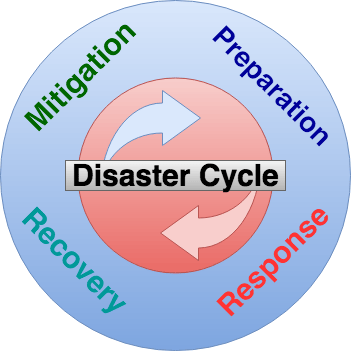
Mitigation has to be part of emergency management, to prevent the disaster from happening in the future or to lessen the negative effects.[11] This includes property buyouts and elevations in Everson. Giving the Nooksack River more room in the floodplain means working with farmers to minimize loss of viable farmland. Because channel excavation transfers risk down river, sediment management must start not in Everson but downstream.[12] Mayor Perry says, “The river is changing faster than we can adapt, with 100-year level flood impacts at 5 to 10 year intervals. Solutions take years to implement and can cause impacts elsewhere. It’s really tough to do anything quickly, bring solutions to our community.”
Flooding and the local response get media attention. (Could that dramatic rescue have been avoided?) Mayor Perry fills in the rest of the disaster cycle: preparation, recovery, and mitigation too. My takeaways: Think Local – this is where the disaster’s impacts are felt; who responds first; how the community will recover. Don’t rely on FEMA.[13] We know that the next disaster is coming even if we don’t know when; it’s time to get ready. Floods, fires, and other hazards are inevitable, but disaster is not.
WHAT YOU CAN DO
1. What is your flood risk? Here are three ways to check, but anywhere can flood.[14]
- FEMA maps show Special Hazard flood zones, but are outdated (https://msc.fema.gov/portal/home).
- Enter your zip code for coastal, inland, and hurricane flood risk ratings, but no map (https://www.floodsmart.gov/flood-zones-and-maps/what-is-my-flood-risk).
- The realtor Redfin (https://www.redfin.com/) lists climate risk ratings for flood, fire, heat, wind, and air. For a handy map, click the thumbnail of the property’s location to make it full-screen and select a climate risk. FEMA and proprietary maps may not agree.
2. Where has it flooded nearby? Did this affect you? How quickly and how well did your city respond?
In my town of Bellingham WA, winter floods caused several road closures, which were manageable using short or long detours. The City Council declared an emergency to speed up infrastructure repair.
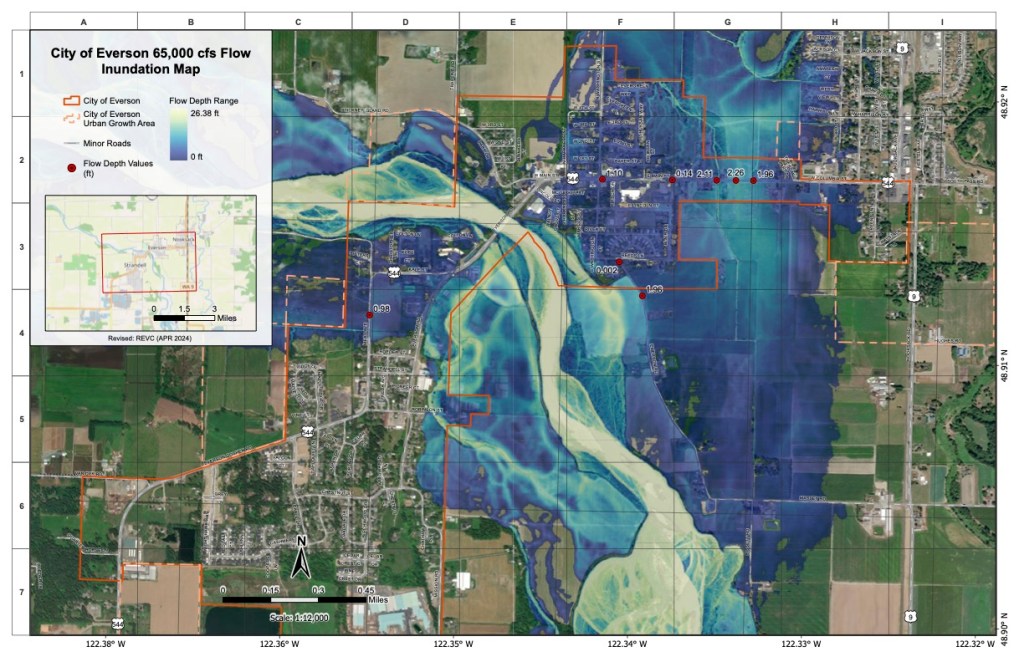
Explore the map of projected flooding to see what roads, water and wastewater plants, and other critical structures might be impacted. Could you evacuate, obtain supplies, reach medical care?
3. Support your local emergency management department or team. Find its website and sign up for alerts. (Also sign up for county and state alerts.) Attend an event on how to prepare for disasters. September is National Preparedness month!
REFERENCES
- The Everson Overflow. John Perry, City of Everson Mayor. Part of “Our Multi-Billion Dollar Challenge. The Nooksack River Today & Tomorrow,” April 22, 2026, Bellingham City Club (https://bellinghamcityclub.org/coming-april-22-nooksack-river/) Many thanks to Mayor John Perry and the Bellingham City Club for permission to quote from the presentation. Watch the mayor tell it!
- The “100-year flood.” USGS, 1996 (https://water.usgs.gov/osw/programs/floods/fs-229-96.pdf). Statistically, there is a 1-in-100 chance that a flood this size will happen during any year; a 1% chance this year, 1% next year, 1% each year.
- These mayors led their cities through two major floods. Here’s what they’ve learned. Gates S, 2026 (https://www.cascadiadaily.com/2026/feb/02/these-mayors-led-their-cities-through-two-major-floods-heres-what-theyve-learned/)
- How FEMA works (https://www.fema.gov/about/how-fema-works). FEMA promotes preparedness, runs the National Flood Insurance Program that provides most US residential flood coverage, offers pre and post disaster grants for mitigation, supports SLTT governments once the President declares a disaster.
- John Perry, City of Everson Mayor, personal correspondence
- Flood risk is widespread in the U.S. Few people have insurance for it. Copley M, 2025 (https://www.npr.org/2025/07/14/nx-s1-5464916/flood-insurance-extreme-weather-climate-change)
- What’s your flood risk? (https://www.floodsmart.gov/flood-zones-and-maps/what-is-my-flood-risk). From 2014 to 2024, 29% of flood insurance claims came from areas outside current high-risk flood areas.
- Whatcom Long Term Recovery Group (https://www.whatcomstrong.com)
- From recovery to resilience. Dr. Lucy Jones Center for Science and Society, 2023. (https://drlucyjonescenter.org/wp-content/uploads/2023/11/DLJCSS-From-Recovery-to-Resilience-Report.pdf). Collaboration speeds recovery. Too slow or too difficult a recovery drives residents and businesses away.
- After devastating flooding, Skagit community stands up its own recovery group. Tellman J, 2026 (https://www.cascadiadaily.com/2026/aug/17/after-devastating-flooding-skagit-community-stands-up-its-own-recovery-group/)
- Breaking the disaster cycle. Getting Through It with Dr. Lucy Jones, episode 69, Oct 1, 2021 (https://www.podbean.com/media/share/pb-2f2w6-10f1929). Good podcast! [Note: disaster “mitigation” should not be confused with climate change mitigation that removes or reduces greenhouse gases in the atmosphere; by preventing and abating disasters it’s a kind of adaptation to climate change impacts.]
- Nooksack River Integrated Planning. 2024 (https://storymaps.arcgis.com/stories/c8cfceedcdb64b3b8fbfa78c4c3bb742)
- What the FEMA Review Council report gets right – and wrong – about flood risk management. Association of state floodplain managers, 2026 (https://www.floods.org/news-views/policy-matters/what-the-fema-review-council-report-gets-right-and-wrong-about-flood-risk-management/)
- How to know your flood risk. Brown C, 2025 (https://www.nytimes.com/2025/07/15/climate/how-to-know-your-flood-risk.html)
IMAGE CREDITS:
> Everson flood inundation maps (https://www.ci.everson.wa.us/applications_forms_maps/maps.php)
> Disaster Cycle, Kyle Schwartz, Wikimedia, CC BY SA 1.0


Leave a Reply