
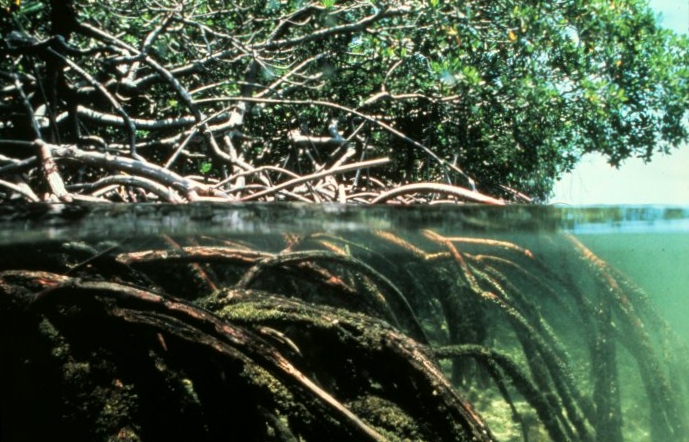
Mangroves are tough, thriving between land and sea, where salty brackish water flows in and out with the tides. The tangled roots provide shelter for fish and shellfish, birds, and animals and a nursery for juvenile species.[1] The Sundarbans in India and Bangladesh, for example, are home to crabs, river dolphins, crocodiles, and Bengal tigers.[2] Coastal peoples find fishing grounds, food, and timber.
“There are no borders here to divide freshwater from salt, river from sea. The tides reach as far as 200 miles inland, and every day, thousands of acres of forest disappear underwater, only to reemerge hours later.”
– Amitov Ghosh, The Hungry Tide
Flooding, the most frequently occurring natural disaster worldwide, is exacerbated by climate change. Warmer waters and moister air intensify cyclones, typhoons, and hurricanes, raising the chances of destructive floods. Mangrove forests can decrease the extent of flooding by slowing down, weakening, and redirecting storm surges, waves, and wind. More extensive mangrove green belts provide greater protection, depending also on storm conditions and topography.[3] From the perspective of insurance data, Hurricane Irma saw $1.5 billion in surge-related flood property damages averted in Florida counties with mangroves, a 25% savings compared to counties without mangroves.[4] Less destructive but more prevalent is disruptive flooding that results from combinations of tides, wind, storms, and sea level rise, as when waves wash over roads and infrastructure and interfere with transportation, commerce, and access to food and supplies.
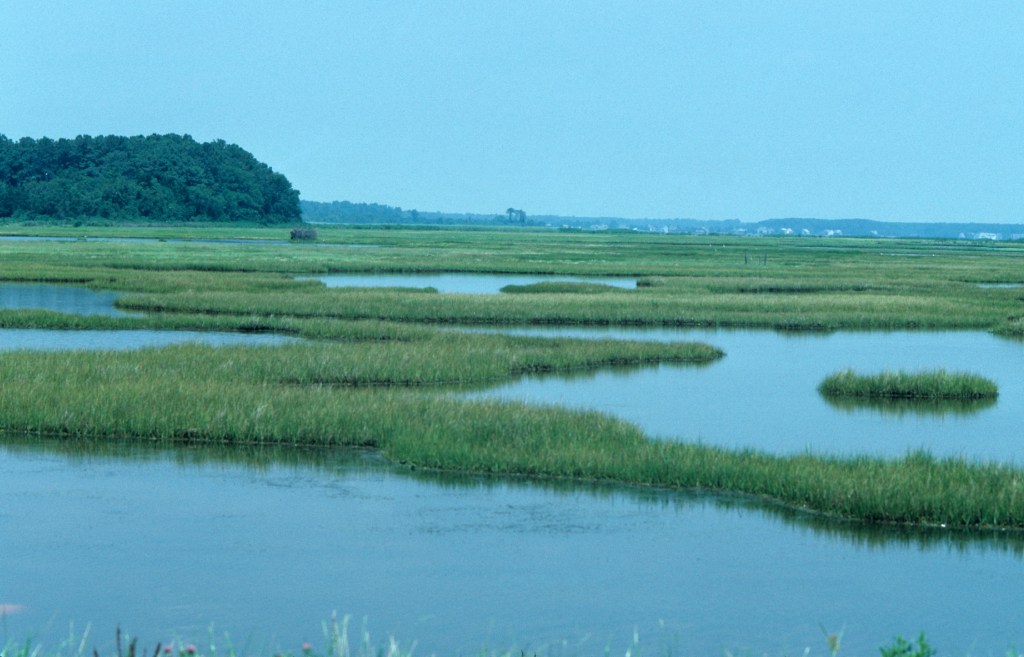
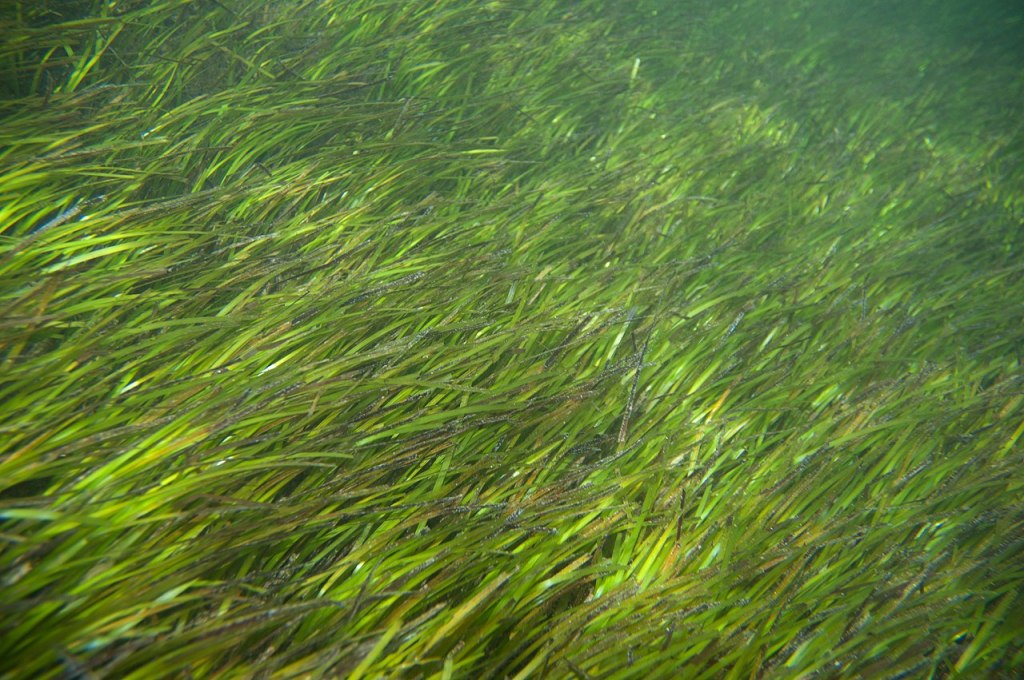
Carbon related to the ocean has been termed “blue carbon,”[5] especially carbon captured in mangrove forests, salt marshes,[6] and seagrass meadows.[7] Such coastal ecosystems can store five times more carbon per hectare than tropical forests, and grow and remove carbon faster. They occupy less area than tropical forests, but are distributed more widely. They collect carbon in their own plant substance and also by trapping suspended matter during tidal inundation, eventually depositing the carbon underground where it is slow to decompose in water-logged oxygen-deprived soil. Freshwater wetlands capture CO2 but also emit methane; saltwater chemistry tends to instead produce hydrogen sulfide. It’s stinky but not a climate-warming gas.[8]
But when mangroves are converted to aquaculture ponds or oil palms or rice fields, when tidal marshes are destroyed for coastal development, when seagrasses die off in pollution-fed algal blooms, carbon is released. Destroying coastal wetlands adds carbon to the atmosphere; protecting blue carbon maintains carbon stores and ongoing carbon absorption. Mangroves, marshes, and meadows are each home to hundreds to thousands of species; they filter pollutants from water, prevent erosion, and buffer coastlines. Preserving and regenerating these ecosystems is a nature-based strategy for dealing with storm surges, rising tides and flooding. Restoration projects are seeing some success.[9][10]
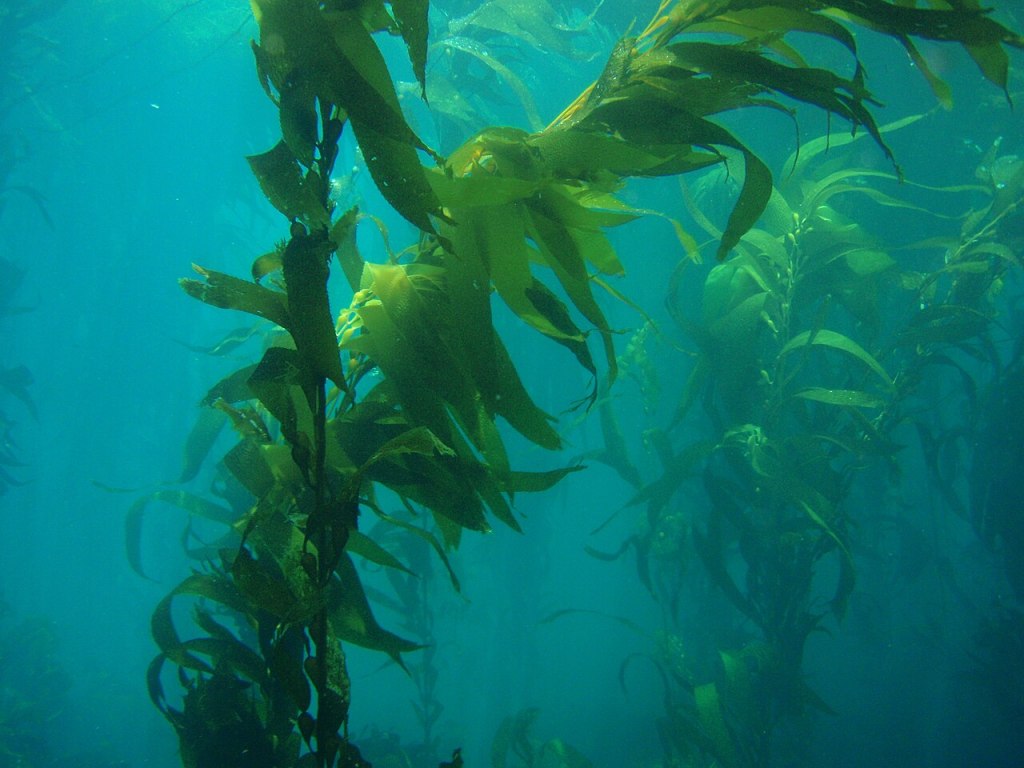
What about kelp? Unlike mangroves, marsh vegetation, and seagrasses, kelp are not plants but large brown seaweeds or macroalgae. Fast-growing kelp rapidly take up CO2 but lack roots to transfer carbon into soil. It’s not easy to trace where the carbon goes. Rafts of kelp wash up on shore, kelp fronds float free, and some sinks. Kelp that decomposes or gets eaten releases carbon; it’s the kelp that descends to the ocean floor that stores carbon long-term. Running Tide tried to market carbon credits for sinking kelp, but the company folded in 2024.[11] Kelp are in decline.[12] As for corals and oysters, these members of the animal kingdom are not considered blue carbon. They release CO2 when forming calcium carbonate skeletons and shells, and there is no net uptake of carbon.[13] These can be appreciated for other reasons, such as the filtering power of oysters and the diversity harbored by coral reefs and by kelp forests.
Climate change solutions fall into several buckets. First is mitigation: reducing greenhouse gas emissions that come from burning fossil fuels or destroying forests and wetlands. Adaptation is managing heat, extreme storms, sea level rise, and other consequences of climate change. But we can’t “adapt our way out”; mitigation and adaptation are both needed. And since we will likely overshoot our carbon budget, a last bucket is for capturing carbon back out of the atmosphere. There’s nothing yet proven to work at scale. Don’t expect miracles. We already have solutions. Blue carbon is one, a win-win for mitigation and adaptation, with co-benefits in biodiversity and community well-being.
WHAT YOU CAN DO
Have you heard of citizen science projects? Kids and adults can get involved in science and help out researchers. If you’re interested, check these out!
- iNaturalist: Record your observations on the app to contribute to biodiversity science.
- eBird: Share your sightings, track your bird lists.
- SciStarter has tons of projects, for all ages, online or in the field. Here are four out of 1774 listed:
- Urchin Density Challenge: Kelp forests are being restored in Norway. Count sea urchins to help track biodiversity inside and outside the restoration area.
- Orcasound: Listen for whales in recordings.
- CrowdWater game: Compare photos of water levels.
- BiodivAquArt: Take pictures of art works featuring an aquatic animal.
- Adventure Scientists: Current projects include preserving Pacific Northwest forest biodiversity and searching for killer whales.
- World Wetland Network ongoing global survey. Fill out an online questionnaire if you know a wetland.
- National Park Service
- NASA
RESOURCES
- Leal M & Spalding MD, eds, 2024. The state of the world’s mangroves 2024. Global Mangrove Alliance. (https://doi.org/10.5479/10088/119867)
- The Hungry Tide, by Amitav Ghosh, 2004. Novel set in the Sundarbans tidelands.
- Van Zelst V et al, 2025. The coastal flood risk benefits of mangroves and tidal marshes. Summary report. (https://oceanwealth.org/wp-content/uploads/2025/08/Van-Zelst-et-al-25-Coastal-flood-reduction-Summary-Report.pdf). For details see: Temmerman S et al, 2023. Marshes and mangroves as nature-based coastal storm buffers. (https://doi.org/10.1146/annurev-marine-040422-092951)
- Narayan S et al, 2019. Valuing the flood risk reduction benefits of Florida’s mangroves. (https://www.nature.org/content/dam/tnc/nature/en/documents/Mangrove_Report_digital_FINAL.pdf)
- Saini V, 2024. From seafloor to sustainability: how blue carbon can save our planet (https://climatefactchecks.org/from-seafloor-to-sustainability-how-blue-carbon-can-save-our-planet/)
- Brook T et al, 2025. The state of world’s saltmarshes 2025. (https://www.wwf.org.uk/sites/default/files/2025-06/state-of-the-worlds-saltmarshes-2025.pdf)
- Reynolds PL, 2013. Seagrass and seagrass beds. Smithsonian. (https://ocean.si.edu/ocean-life/plants-algae/seagrass-and-seagrass-beds)
- Marshes, mangroves, meadows. Ask MIT Climate podcast with guest Julie Simpson, 2026. (https://climate.mit.edu/podcasts/e1-marshes-mangroves-meadows)
- Guidelines on mangrove restoration for the Western Indian Ocean Region, 2020. (https://www.unep.org/resources/report/guidelines-mangrove-restoration-western-indian-ocean-region)
- Restoration works: Paddison L, 2021. World’s largest seagrass project proves “you can actually restore the oceans.” (https://reasonstobecheerful.world/worlds-largest-seagrass-project-proves-you-can-actually-restore-the-oceans/)
- Cornwall W, 2024. Sinking seaweed. An ambitious strategy aims to cool the planet by dumping farmed seaweed on the sea floor. Will it work? (https://www.science.org/content/article/can-dumping-seaweed-sea-floor-cool-planet-some-scientists-are-skeptical)
- Eger AM et al, 2024. State of the world’s kelp forests. (https://doi.org/10.1016/j.oneear.2024.10.008) – snapshot. For a detailed report see: Into the blue. United Nations Environment Programme, 2023. (https://www.unep.org/resources/report/blue-securing-sustainable-future-kelp-forests)
- Brodeur J et al, 2022. NOAA blue carbon white paper. (https://repository.library.noaa.gov/view/noaa/40456)
NOTE: Colors of carbon: brown carbon is greenhouse gases, black carbon is particles like soot, green is in plants and soil on land. See: Nellemann C, et al, 2009. Blue carbon. The role of healthy oceans in binding carbon, fact box 1. (https://portals.iucn.org/library/sites/library/files/documents/2009-052.pdf).
IMAGES, all from National Oceanic and Atmospheric Administration Photo (NOAA) digital collection:
- Mangroves, presumably in Bangladesh. Public domain.
- Salt marsh, Delmarva Peninsula, Virginia. Dr. Dwayne Meadows.
- Thick seagrass, Wakaya, Fiji. Paul Asman and Jill Lenoble. Creative Commons Attribution 2.0 Generic license.
- Giant kelp, Channel Islands, California. Claire Fackler. Creative Commons Attribution 2.0 Generic license.


 cloudy climate
Leave a reply to Shirley Cancel reply