
Map of the Delta Works
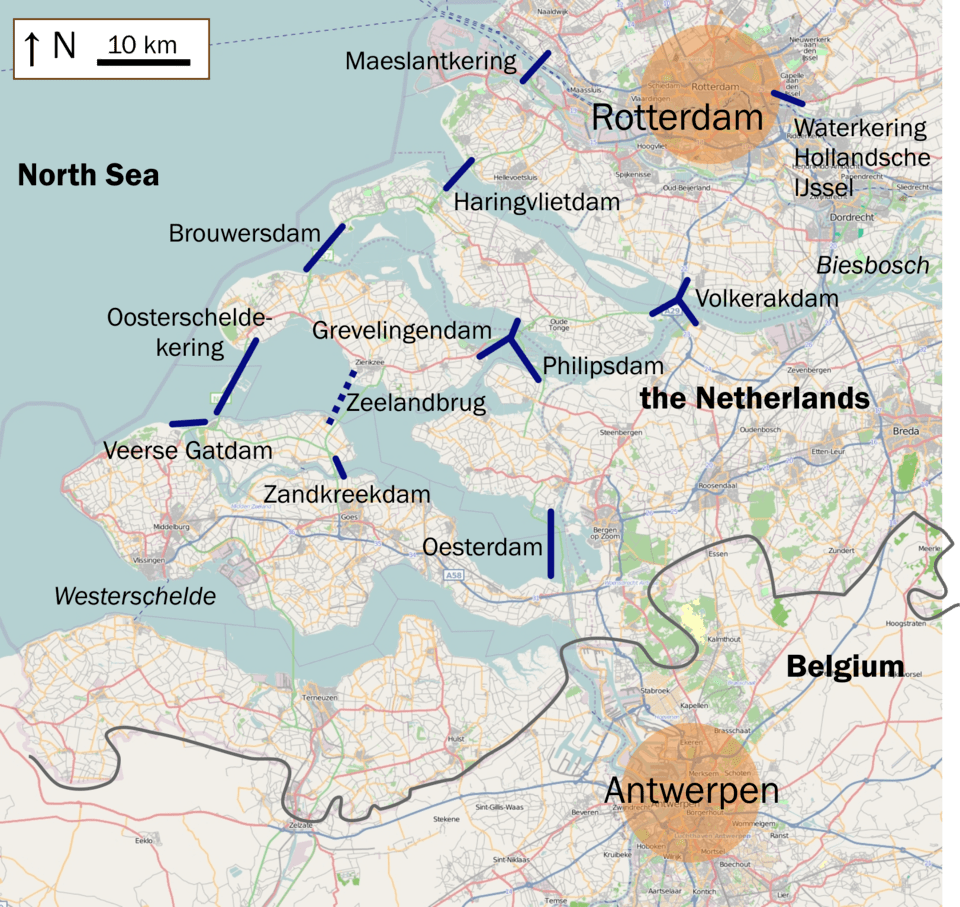
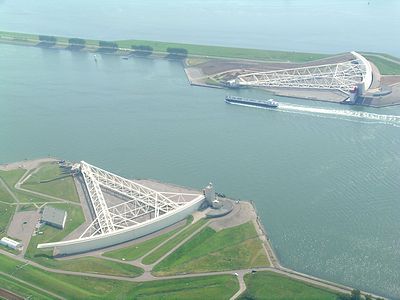
The Maeslantkering is on my travel wish list.[1] A Rick Steves tour itinerary reads: “Today we’ll discover how a country stays dry when nearly half of its land is below sea level… with a tour of one of earth’s largest moving structures — the Maeslant storm surge barrier….”[2] The Netherlands has been battling the sea for centuries. The flood disaster (Watersnoodramp) of 1953 prompted the Delta Works, a mega-project closing off multiple sea inlets, finished in 1997.[3]
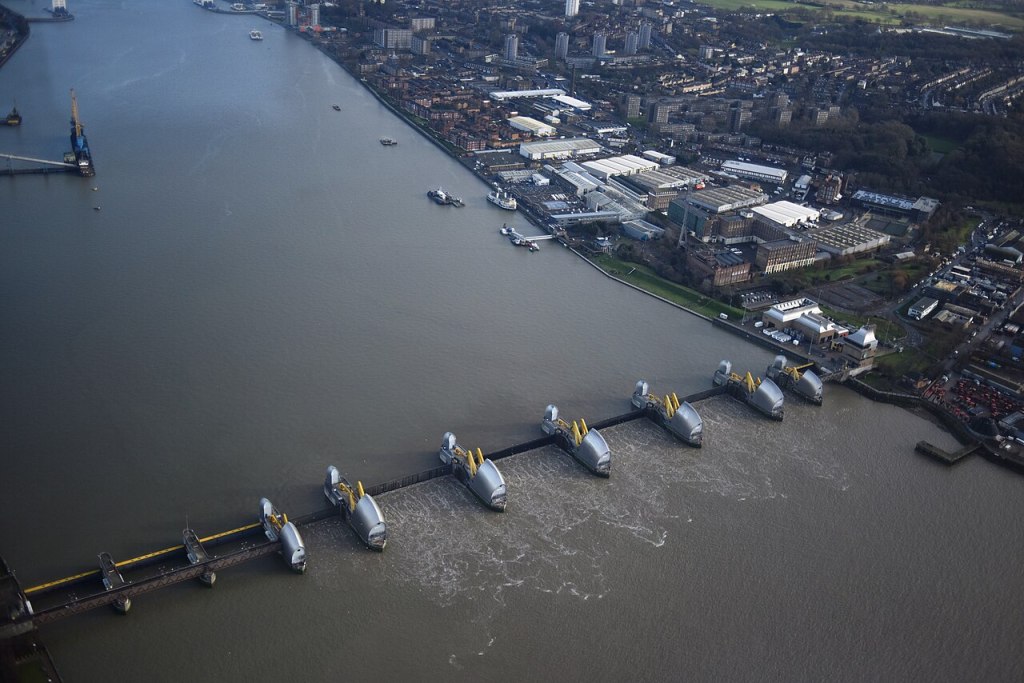
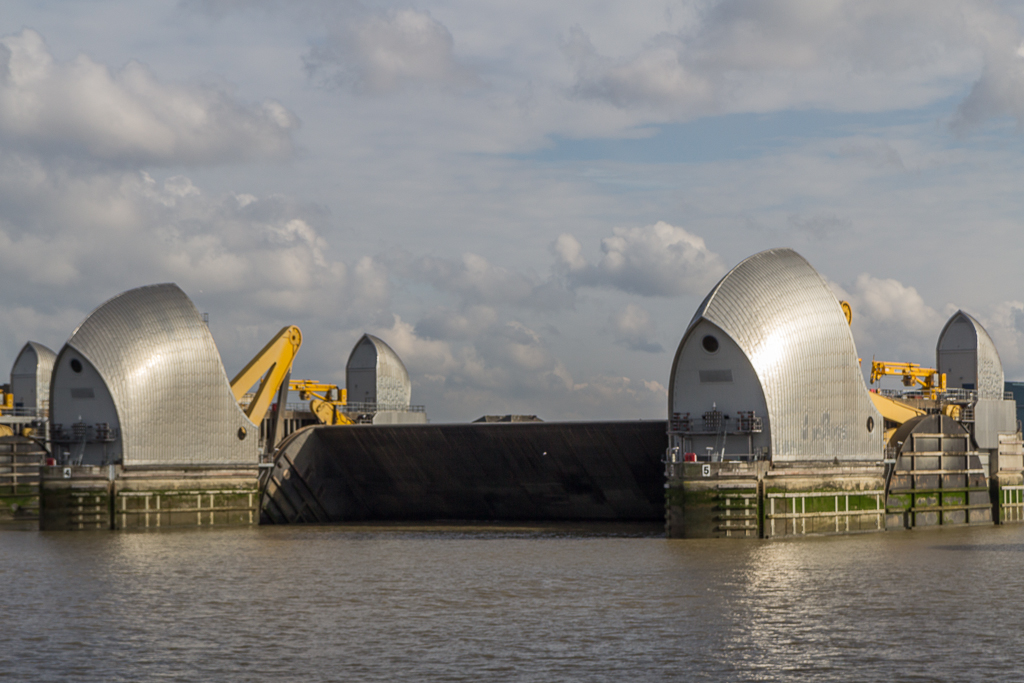
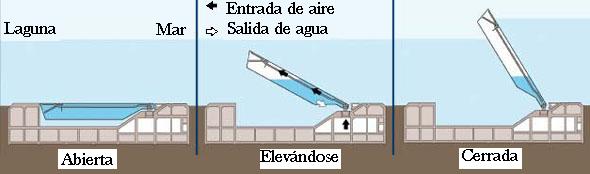
The same Great North Sea Flood led to the Thames Barrier. It took 30 years to build and was completed in 1984: 10 steel gates that rotate up to the height of a five-story building. By its 40th anniversary, it had been closed 221 times to protect London.[4] The Thames Estuary 2100 Plan is reviewed every 10 years. Also famous, or maybe infamous, is the MOSE: 78 steel gates that fill with air to rise up and hold back the sea. A response to the Great Venetian Flood of 1996, it was begun in 2003, and first deployed in 2020, after delays and scandal.[5] As higher tides come more frequently, the floodgates are more often closed, becoming a near permanent unattractive wall around a stagnant lagoon.[6]
Concrete seawalls, rocky revetments, dikes, bulkheads, and breakwaters are more common “hard” coastal defenses. The immobile barriers protect landward structures but disrupt natural tidal flows of water and sediment and shoreline flow of sand, and can lead to loss of beaches, wetlands, and habitats.[7] Beach nourishment is a temporary fix, needing repeated replenishment of sand, a finite resource.[8] Hard armoring is often expensive and requires maintenance. Walls can also falsely reassure, leading to more urban development in hazardous zones (maladaptive, because it increases exposure to flood risk).
Mangroves, salt marsh wetlands, seagrass, and coral and oyster reefs protect shores by dissipating the force of waves and stabilizing sediment, and additionally preserve habitat, provide food, and filter water, and some store carbon. These can be preserved, restored, and extended where present, as “soft” defenses with co-benefits. Full ecosystems take time to establish and require more space, but become more protective as they grow, self-recover, and migrate with rising waters.[9] Sediment-based beaches, dunes, and barrier islands also provide natural protection.
Hybrid defenses combine hard and soft features. For example, Staten Island’s “Living Breakwaters” are artificial reefs made up of islands of concrete and rock designed with niches and crevices, offering the protection of breakwaters but also already welcoming nesting birds, migrating seals, and tidepool denizens like snails, crabs, and shrimp.[10] Eventually oysters will be added by the Billion Oyster Project that is building oyster reefs across New York Harbor.[11] Shoreline protection needs to fit the environment; living shorelines are favored for sheltered coasts.[12] Both natural and hybrid gray-green defenses are called living shorelines, nature-based initiatives, or soft protection.
Worldwide, more and more people live on the coast – a billion, or 14.6% of the global population, on 4% of the landmass.[13] Exposed to flood risk are: densely populated cities and countries where the population is concentrated on the coast; also small islands, sinking cities and deltas, and low-lying lands; also vulnerable places with less technical and financial resources to respond and adapt. Even without headline disasters, communities are grappling with flood events that occur with high tides, heavy rain, or big winds or waves, worsened by rising sea levels.[14] This becomes more than “nuisance” flooding if groundwater, wastewater systems, and infrastructure are impacted.
What to do? The US Army Corps of Engineers is proposing coastal projects for Boston, Charleston, Houston-Galveston (“Ike Dike”), Miami-Dade (seawall rejected and not present in the second draft), New York-New Jersey, and Norfolk, Virginia.[15] The Norfolk seawall is the closest to starting construction, not without controversy.[16] Seawalls are not the only answer and protection is not the only adaptation approach to flood risk. What are other cities doing? Stay tuned!
REFERENCES
- Matey-Coste S, 2024. Learning from the low lands #2: a council in the sea kingdom. (https://sammatey.substack.com/p/learning-from-the-low-lands-2-a-council?utm_medium=email). An enthusiastic account of visiting the Oosterscheldekering, from “The Weekly Anthropocene”
- Heart of Belgium & Holland in 11 days tour 2026 (https://www.ricksteves.com/tours/holland-belgium/belgium-holland)
- The history of the Delta Works (https://www.watersnoodmuseum.nl/en/water-knowledge/learn-about-water-safety/articles/the-history-the-delta-works)
- Warren J, 2024. London’s Thames Barrier marks 40th anniversary (https://www.bbc.com/news/uk-england-london-68972351)
- MOSE, Wikipedia accessed 4/9/2026 (https://en.wikipedia.org/wiki/MOSE)
- Moraca S, 2024. Venice’s flood barriers are working overtime. How will they change the lagoon? (https://www.nature.com/articles/d43978-024-00062-x )
- Seawalls, bulkheads, and revetments, part of a series on coastal engineering-hard structures, National Park Service, updated 2019 (https://www.nps.gov/articles/seawalls-bulkheads-and-revetments.htm)
- Gaskill M, 2024. Coastal restoration: shifting sand-for better or worse (https://therevelator.org/beach-renourishment/)
- Sutton-Grier AE, Wowk K, Bamford H, 2015. Future of our coasts: the potential for natural and hybrid infrastructure to enhance the resilience of our coastal communities, economies and ecosystems (http://dx.doi.org/10.1016/j.envsci.2015.04.006). See Table 1 for infrastructure strengths and weaknesses
- Attanasio C, 2024. These artificial reefs off a New York City beach help sea creatures. They might also save lives (https://apnews.com/article/sea-wall-staten-island-sandy-11723ba69d8753bbee5e1dca97285cb3)
- Uteuova A, 2022. Can nature-based alternatives to seawalls keep the waves at bay? (https://www.theguardian.com/us-news/2022/aug/12/seawalls-nature-based-alternatives-us)
- Living shorelines, National Oceanic and Atmospheric Administration (https://www.habitatblueprint.noaa.gov/living-shorelines/)
- Cosby A & Lebakula V, 2024. 15% of global population lives within a few miles of a coast – and the number is growing rapidly (https://theconversation.com/15-of-global-population-lives-within-a-few-miles-of-a-coast-and-the-number-is-growing-rapidly-240672). 2018 pop. within 10 km/6.2 mi from coast
- Spanger-Siegfried E et al, 2014. Encroaching tides: How sea level rise and tidal flooding threaten US East and Gulf Coast communities over the next 30 years. Union of Concerned Scientists (https://www.ucs.org/resources/encroaching-tides)
- Miller MS & Wyman KM, 2026. Collaborative climate change adaptation: A case study of Army Corps coastal protection projects (https://doi.org/10.52214/cjel.v51i1.14599 ) Detailed process review. Benefit-cost analysis has focused on avoided property damage; shifting to net public benefits metric.
- Morrison J, 2026. Cost of Norfolk floodwall project balloons to $6 billion, completion slated for 2037 (https://virginiamercury.com/2026/03/20/cost-of-norfolk-floodwall-project-balloons-to-6-billion-completion-slated-for-2037/)
EXTRA: Japan is a special case because its seawalls were built for tsunami protection. See what the walls look like: Lim M, photography by Kyung-Hoon K, 2018. After tsunami, some Japanese are feeling walled-in (https://widerimage.reuters.com/story/after-tsunami-some-japanese-are-feeling-walled-in)
IMAGE CREDITS
- Maeslant Barrier. DeltaWorks Online-Eszter Simonfi. CC BY-SA 3.0
- Map of the Delta Works in Zeeland, Netherlands. Classical geographer. CC BY-SA 1.0
- Thames Barrier raised Environment Agency aerial photograph. Defra Data Services Platform. Open Government License v3.0.
- Thames Barrier. Geograph Britain and Ireland. copyright Christine Matthews. CC BY-SA 2.0.
- MOSE. Alfredobi. Public domain.
SOMETHING TO DO
I am learning about my surroundings, the Salish Sea, Lake Whatcom, Nooksack River, etc. What waters are near you? Look on a map or try these digital tools:
- USGS Streamer lets you trace larger American rivers and streams upstream to their source or downstream to where they empty. (https://webapps.usgs.gov/streamer/)
- The USGS National Hydrography Dataset is more detailed, but takes a while to load. (https://www.arcgis.com/home/item.html?id=8ff0911acb2f4d4d879736d6a611a366). I chose Map View, closed the Layers sidebar on the left, and moused to my town. The key to the overlays is on the right, e.g. dotted lines for intermittent flows and arrowheads for flow directions.


 cloudy climate
Leave a comment