
Dear readers: I am re-sending “Sponge CIties” to replace an earlier version that was distributed inadvertently. -Shirley
The idea of a sponge city is “to allow the natural flow to come back” from the urban build-up of concrete and impermeable surfaces; to use a wetland or spongy system to absorb, clean, and hold the water instead of quickly draining it away. “We can make friends with water,” said Chinese landscape architect Kongjian Yu.[1] China initiated 30 pilot sponge cities in 2015-2016 and aims for 80% of urban areas to be able to absorb and use 70% of local rainfall by 2030.[2]
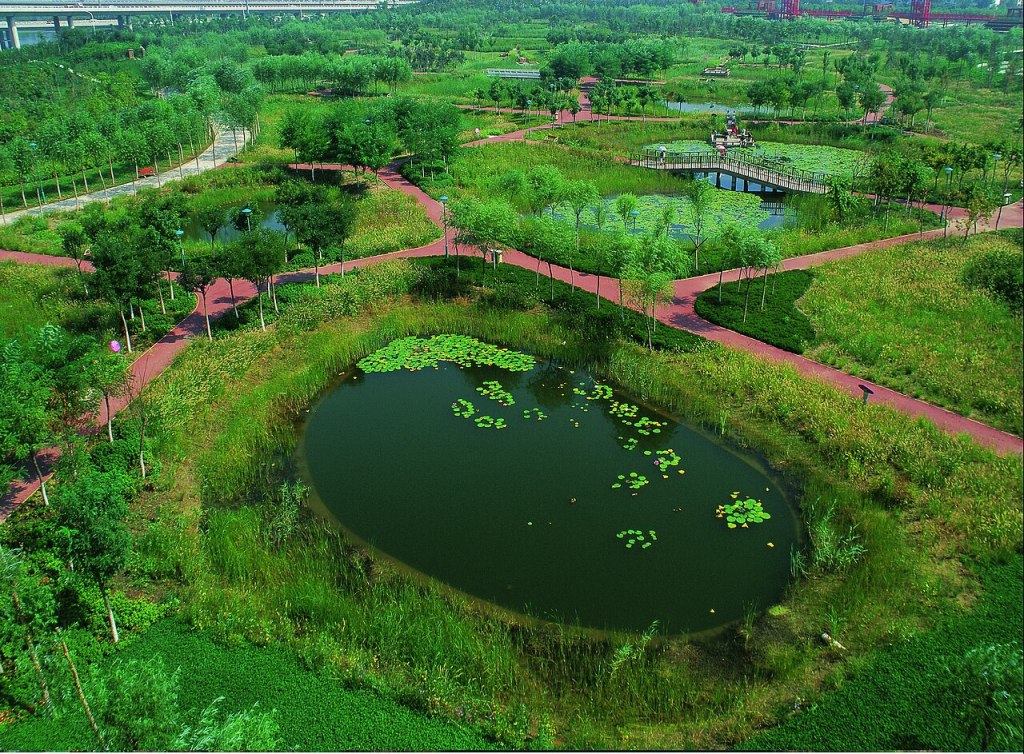
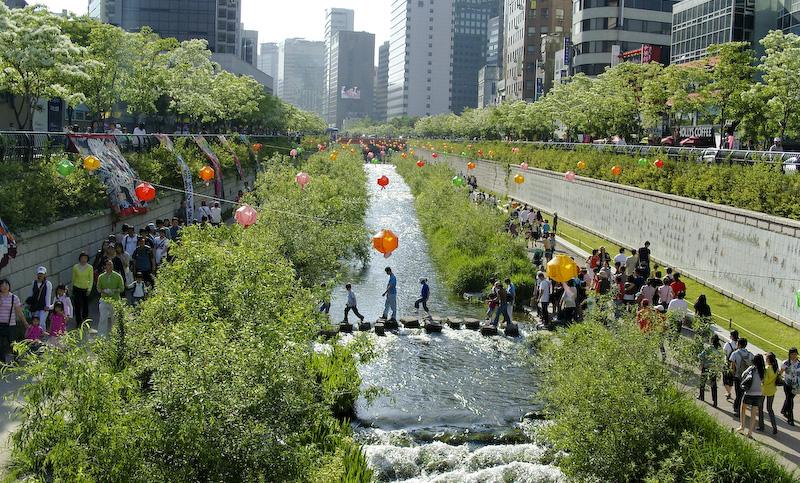
Spongy elements manage rain where it falls, flows, and accumulates. Permeable pavements, made from porous materials or with spaces between paving blocks, let water seep into the ground, reducing surface runoff, and can be used for lightly trafficked roads, driveways, parking lots, and pedestrian areas. Green roofs absorb rainwater and evaporation reduces building heat. Rain gardens and bioswales are vegetated shallow beds or channels that soak up stormwater or convey it slowly into drainage systems. Detention and retention ponds temporarily or indefinitely hold water, giving sediments and pollutants a chance to settle out. Restored wetlands and waterways accommodate floodwater and support ecosystems.[4]
Similar green infrastructure may be part of stormwater management, used to minimize flooding and decrease water pollution. Extreme downpours are increasing in frequency and severity, as warmer air holds more moisture.[5] How much rain matters but also how fast it falls; several months’ worth of rain dumped in a couple days or two inches in a 30-minute cloudburst can overwhelm drainage systems. In urban environments, rainfall travels over impermeable driveways, streets, parking lots, sidewalks, and compacted dirt, and picks up trash, pet waste, debris, chemicals, detergents, vehicular oil and gasoline, and other pollutants. This stormwater flows into local waterways and is a threat to water quality.[6]
Most commonly in the US, wastewater and stormwater are carried in separate sets of pipes. But in the hundreds of communities (including my home Bellingham) that have older combined sewer systems, wastewater and stormwater flow through the same pipes.[7] So as not to back up the system during wet weather, overflow is directed into nearby waterbodies. The discharges of stormwater and untreated human and industrial waste pollute the environment and raise public health concerns.[8] Spongy features that absorb and retain stormwater can help limit combined sewer overflows.
Sponge cities have experienced flooding – do they work? Some of the challenges: poor or incomplete implementation, ignoring local conditions, not enough land available, pre-existing infrastructure, regional upstream or coastal flood pressures.[4] Handling large volumes of water may require tunnels, tanks, and pumps.[9]
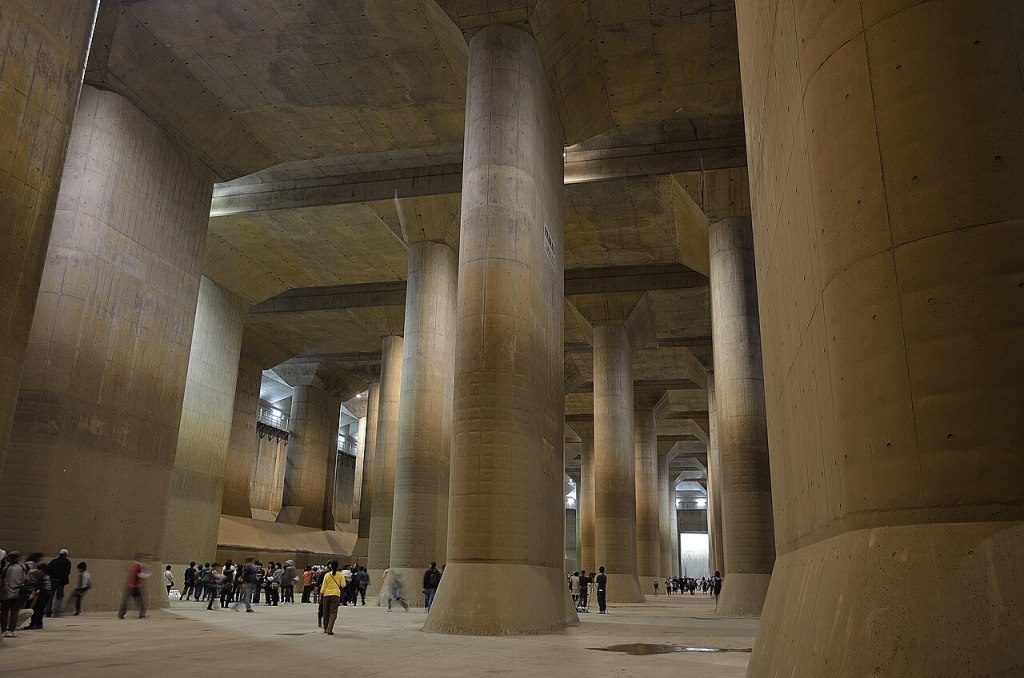
Tokyo is choosing engineering, on a massive scale. It took 17 years to construct five large vertical shafts and connecting flood tunnels, that divert floodwater into an enormous storage tank. This “underground temple” can hold 670,000 cubic meters of water and is now a tourist destination.[10]
In Copenhagen, nature-based and gray engineered solutions work together, to address flooding but also to make places for people to enjoy. Parks and gardens retain and purify stormwater, collection basins are also skate parks and amphitheaters, a campus event space is a catchment for rainwater. In Enghaveparken has levels of water storage: a rose garden, sports grounds, or a big floodgate-bound basin that can hold 22,000 cubic meters (~6 million gallons).[11] More green means less gray infrastructure is needed. Halfway to completion, the Cloudburst Management Plan has reduced Copenhagen’s flood risk by 30-50% in high-priority areas.[12]
Seawalls and living shorelines are defenses against coastal flooding, but don’t help cities inundated by intense precipitation. Even if your town doesn’t have a combined sewer system, it likely has aging infrastructure. Upgrading is an opportunity to prepare for future stresses and improve public spaces. Spongy design supplemented by engineering accommodates downpours and makes cities safer and better.
PHOTOS
- Tianjin Qiaoyuan Park: restored habitat retains stormwater and creates a public space. Credit: Mydogistiaotiaohu, Wikimedia, CC BY-SA 4.0
- Cheonggyecheon Stream, Seoul, South Korea: from run-down highway to popular pedestrian walkway. Credit: stari4ek, Wikimedia, CC BY-SA 2.0
- Underground temple, G-Cans, Saitama prefecture outside Tokyo, Japan. Credit: AMANO Jun-ichi, Panoramio, CC BY SA 3.0
WHAT YOU CAN DO… to protect our waterways from stormwater pollution[13]
- Direct water from downspouts to grassy areas
- Use fertilizers and pesticides sparingly
- Collect your yard debris and compost it; leaves and yard clippings can clog storm drains
- Sweep up driveways, sidewalks, gutter
- Pick up after your pet and trash the waste
- Dispose of paints and chemicals properly
- Purchase detergents and cleaners that are low in phosphorus
- Visit the car wash or wash the car on your lawn.
- Check your car for leaks and recycle your motor oil
- Properly inflate tires, for a safer ride, less tire wear, and release of fewer tire particles
- Have your septic system inspected and pumped regularly
- Never dump anything down storm drains or in streams
REFERENCES
- This man is turning cities into giant sponges to save lives. [circa 2019; video 4:27] (https://www.weforum.org/videos/this-man-is-turning-cities-into-giant-sponges-to-save-lives/)
- “Sponge city” theory and practice by Kongjian Yu and his team, accessed 19 May 2026. (https://www.turenscape.com/topic/en/spongecity/index.html). Turenscape is Kongjian Yu’s design firm.
- Carraso M, 2024. Re-naturalization of urban waterways: the case study of Cheonggye Stream in Seoul, South Korea. (https://www.archdaily.com/1020945/re-naturalization-of-urban-waterways-the-case-study-of-cheonggye-stream-in-seoul-south-korea)
- Jones, F, 2024. How sponge cities can help prevent flooding. (https://revistapesquisa.fapesp.br/en/how-sponge-cities-can-help-prevent-flooding/). Other systems: sustainable urban drainage systems (SUDS, UK), low-impact development (LID, US), water-sensitive urban design (WSUD, Middle East & Australia)
- Climate extremes: extreme weather, 2025. (https://www.youtube.com/watch?v=X6VCTfzl1DU). Documentary [40:58] with J Rockström, D Swain, and others; website (https://www.climate-extremes.com)
- Montalto F, 2024. As climate change amplifies urban flooding, here’s how communities can become ‘sponge cities’. (https://theconversation.com/as-climate-change-amplifies-urban-flooding-heres-how-communities-can-become-sponge-cities-217075). Don’t miss the video, “Copenhagen: how to flood-proof a city” [10:53, DW Planet A, 2023].
- Combined sewer overflow basics. EPA, updated 2025. (https://www.epa.gov/npdes/combined-sewer-overflow-basics) – see US map
- Rhea D, updated 2024. What are combined sewer overflows? (https://extension.psu.edu/what-are-combined-sewer-overflows) – see video [5:42]
- Choi C, 2024. Why turning cities into ‘sponges’ could help fight flooding. (https://www.cnn.com/2024/08/13/style/china-sponge-cities-kongjian-yu-hnk-intl/)
- Tokyo Flood Tunnels, 2024. https://japandaily.jp/the-tokyo-flood-tunnels-engineering-marvel-to-combat-urban-flooding/
- Klinenberg E, 2026. Can sponge cities save us from the coming floods? (https://www.newyorker.com/magazine/2026/04/13/can-sponge-cities-save-us-from-the-coming-floods). Visits Copenhagen, Hoboken New Jersey, NYC
- Hockenos P, 2025. ‘Sponge city’: Copenhagen adapts to a wetter future. (https://e360.yale.edu/features/copenhagen-sponge-cities)
- a) Be stormwater smart. EPA. (https://www.epa.gov/system/files/documents/2022-10/Stormwater%20Smart%20Brochure_Suburban%20Steps_September%202022.pdf)
b) Stormwater, 10 Things you can do to prevent stormwater runoff pollution. Wikipedia accessed 30 May 2026. (https://en.wikipedia.org/wiki/Stormwater)


 cloudy climate
.jpg)

Leave a comment